

If you own agricultural land in England, the size of your holding is critical when it comes to permitted development rights on farmland. While the 0.4-hectare threshold blocks rights for the very smallest holdings, the next key cut-off is 5 hectares.
Land between 0.4 hectares and 5 hectares sits in a grey zone: you do have some rights, but they’re limited compared with larger farms. For landowners, this can mean the difference between straightforward diversification and a planning headache.

At Intelligent Land, we work with owners in this exact position. Using the Land Value Accelerator™ (LVA Method™), we identify what can and can’t be done, explore alternative scenarios, and often unlock significant hidden value – increasing the value of your land.
What the Law Says: The 5-Hectare Threshold
The General Permitted Development Order (GPDO) splits agricultural units into two categories:
- Under 0.4 hectares – no Class B agricultural permitted development rights (read more).
- 0.4 hectares to 5 hectares – some permitted development rights, but on a reduced scale.
- 5 hectares or more – the full range of agricultural permitted development rights applies (read more).
This middle band (0.4–5 ha) is where most confusion arises. Owners expect the same freedoms as larger farms leading to increased farmland value, but in reality, their rights are restricted by floor space limits and building types.
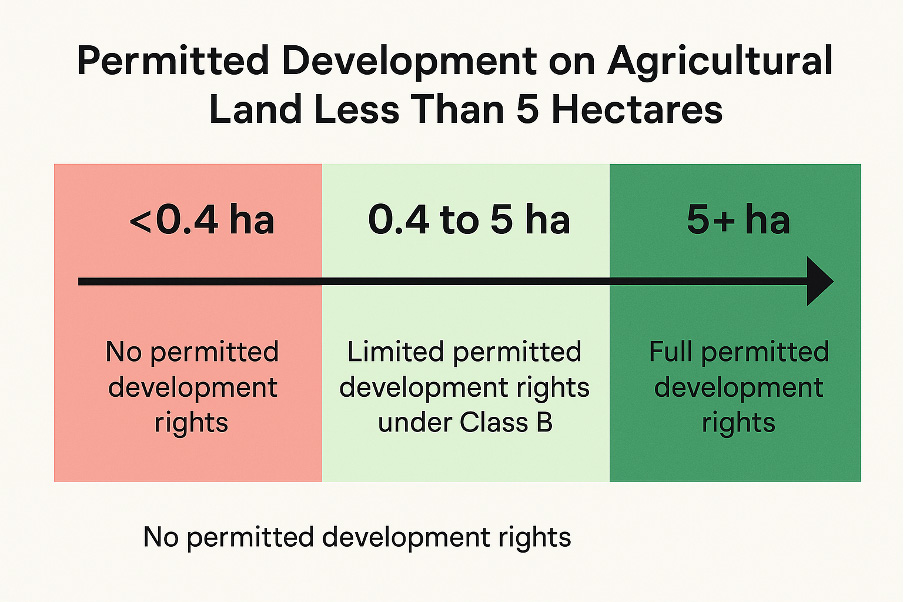
Permitted Development on Agricultural Land Less Than 5 Hectares
If your land is between 0.4 and 5 hectares, you may benefit from Class B rights. These include:
- Erecting, extending, or altering agricultural buildings, provided they are less than 1,000 square metres in floor space.
- Installing certain works such as hard surfaces, private ways, or drainage.
- Housing plant or machinery required for farming.
However, there are strict limitations:
- Buildings must be reasonably necessary for the purposes of agriculture.
- The location, size, and design must avoid significant impact on the surrounding area.
- Rights do not apply in designated areas like AONBs, National Parks, or where Article 4 Directions are in place.
What You Cannot Do
Compared with units above 5 hectares, land under the threshold faces tighter controls:
- Size Cap – the 1,000 m² limit often rules out larger barns or storage units.
- Residential Use – converting barns into dwellings under Class Q is subject to separate rules and doesn’t automatically follow.
- Change of Use Flexibility – fewer routes exist for farmland diversification into commercial or mixed-use operations without full planning.
In practice, many landowners hit a ceiling quickly, discovering that the “freedom” of permitted development is narrower than expected.
The Value Impact
The planning status of land between 0.4 and 5 hectares has direct implications for:
- Market Value – parcels that can support barns, storage, or tracks are more valuable than those restricted by policy or designation.
- Diversification Potential – farm shops, equestrian use, and renewable energy projects may all require a full application.
- Financing & Investment – lenders often view land with PD rights as lower risk, improving borrowing potential. Here’s why land can be such a good investment.
Failing to factor these nuances into valuation can mean under-selling — or overpaying.
How the LVA Method™ Supports Medium-Sized Holdings
This is where Intelligent Land’s expertise pays off. The Land Value Accelerator™ (LVA Method™) follows a three-step process tailored to land under 5 hectares:
- Review Planning Permissions – determine precisely what Class B rights apply and whether the agricultural unit could be redefined.
- Undertake Research – test constraints like AONB status, biodiversity net gain requirements, or local policy quirks.
- Scenario Testing – run thousands of AI-driven models to identify the most value-enhancing options, from barn conversion planning permission or extensions to diversification strategies.
In many cases, we identify opportunities to reframe the landholding or pursue underused rights, leading to £1m+ uplifts within 24 hours.
Case Example
A client with 3 hectares assumed their only option was full planning for a new storage barn which can often be an uncertain and costly process. Our LVA Method™ revealed that, by slightly adjusting the siting and reducing the footprint, the proposal fit neatly within Class B.
Result: planning avoided, building delivered, and land value uplifted by £750,000.
Frequently Asked Questions
- Can multiple smaller parcels be counted together? Yes, if they are occupied as one agricultural unit, the total area may exceed 5 hectares, unlocking broader rights.
- What’s the maximum building size under 5 hectares?
1,000 m² of floor space for agricultural buildings, subject to prior approval in some cases - Do diversification projects (farm shops, stables, etc.) qualify?
Usually not. Most non-agricultural uses require a full planning application, though alternative permitted routes may exist. Read more about planning permission for stables.
Conclusion: Unlocking Value Under 5 Hectares
Owning agricultural land under 5 hectares offers some rights, but not the full package. Knowing exactly where you stand when developing on agricultural land and how to push the boundaries strategically is the key to unlocking hidden value.
At Intelligent Land, we combine black-box AI insights with white-glove planning expertise to cut through the uncertainty and deliver results.
Have land between 0.4 and 5 hectares? Unlock hidden millions today with the Land Value Accelerator™.


