
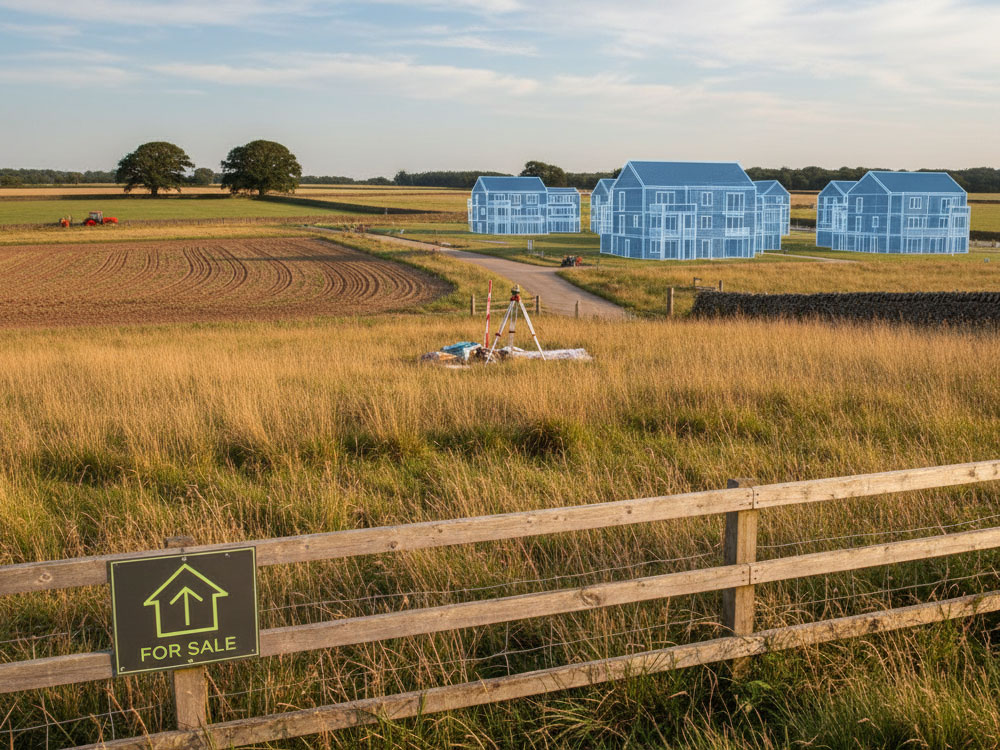
Some think that buying land for development in the UK is about finding a cheap plot in the right location and then waiting for the value to creep up.
But that’s not where the real money is.

The real gains come from planning uplift where you turn “a piece of land” into “a consented, clearly developable site” with a much higher end value. In other words: you don’t just buy land; you buy the right to do something more valuable with it.
This guide is for you if you’re:
- Wanting to know how to buy land for development
- Looking to buy development land as a long-term investment
- Considering buying land for residential development or small schemes
- Or you already own land and suspect it could be worth a lot more with the right strategy
Along the way, you’ll see where Intelligent Land’s Land Value Accelerator™ (LVA Method™) fits in when you’re buying land for development, and then when you’re ready to force extra value out of what you already own.
Buying Development Land for Investment in the UK
1. What Does It Actually Mean to “Buy Land for Investment”?
When we talk about land investment here, we mean to buy land for development that’s intended for residential or business use – not farmland for farming’s sake, and not purely speculative green fields with no realistic route to development.
In the current UK context, that matters more than ever:
- The government has committed to building 1.5 million new homes in this parliament, with a major planning overhaul to speed up delivery and focus on brownfield and “grey belt” sites.
- The National Planning Policy Framework (NPPF) was revised in December 2024, tightening expectations on local plans and giving more emphasis to delivering homes quickly and efficiently.
- Biodiversity Net Gain (BNG) is now mandatory for most developments in England, requiring at least a 10% net gain in biodiversity for qualifying schemes – including small sites.
So, if you’re buying land for development, you’re really doing three things at once:
- Buying a physical asset (the land).
- Buying into a planning context (what policy and constraints say you can or can’t do).
- Buying an option on future value (how much uplift you can unlock via planning and design).
Intelligent Land’s view is simple: The land is the canvas. The planning system and local context are the rules. Your uplift comes from how intelligently you play within those rules – which is where we help.
2. Before You Start: What Are You Really Trying to Achieve?
Before you Google “how to buy land for development”, pause and get clear on your actual objective.
Are you primarily:
- An investor – wanting to buy development land, de-risk it through planning, and sell on the uplift?
- A developer or JV partner – planning to take schemes at least part-way through build?
- A business owner – want to buy development land for your own premises but keen to retain long-term development value?
- A long-term land banker – willing to bank land and hold for years while policy and infrastructure catch up?
Your strategy shapes:
- What kind of land you should target (urban infill vs edge-of-settlement vs brownfield).
- Whether buying land for residential development is right, or whether mixed-use / commercial plays make more sense.
- How much planning risk you can tolerate before exchange.
This is where many people go wrong: they chase “a bargain”. Professionals chase the right combination of planning potential, constraints and timing.
3. How to Find Land for Development
You can find development land in dozens of ways. A few of the main routes:
- Agents and land brokers – local commercial agents, land & new homes teams and specialist land agents.
- Auction catalogues – often full of “opportunity, STPP” sites that need careful due diligence.
- Online portals and land platforms – some focused purely on land and small development opportunities.
- Direct to owner – writing to owners of under-used sites, yards, back land and large gardens.
- Planning history mining – searching local planning portals for refused or lapsed schemes that could be improved.
The important point isn’t where you find a site. It’s how you assess it like a professional once you do.
4. How to Buy Land for Development Without Flying Blind
When you’re buying land for development, the worst thing you can do is fall in love with the idea of the scheme and then try to make the facts fit it.
Professionals do the opposite: they attack the site with questions.
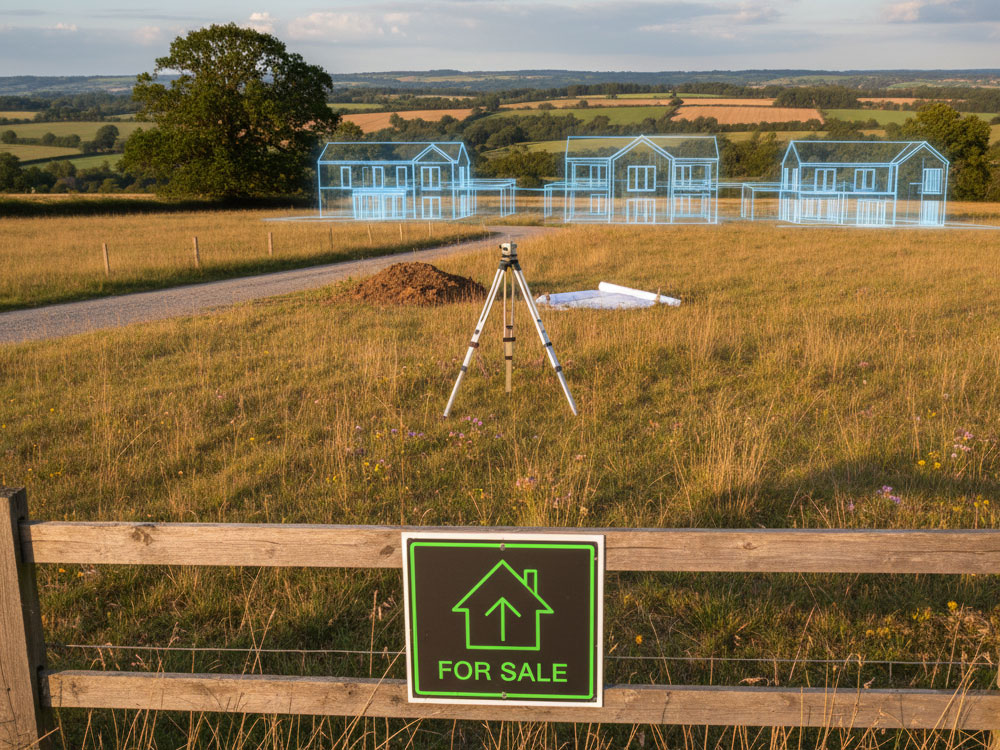
4.1 Planning permission: the non-negotiable starting point
Planning is the main engine of value. Whether you buy development land that already has planning permission or not, you need to understand:
- What’s allowed now? Existing consents, lawful uses, permitted development potential.
- What has been tried before? Past applications, refusals, appeals, pre-app advice.
- What the local plan and NPPF say about the site’s role in housing or employment land supply.
Buying land for development without planning permission can be a smart move – if you understand the planning probabilities. It can also be an elegant way to burn capital if you don’t.
This is where many Intelligent Land clients first come to us:
“We’re about to buy this site. Can the Land Value Accelerator™ quickly tell us what’s realistically achievable?”
Using the LVA Method™, we can often give a planning-led view of the upside within 24 hours, before you exchange contracts.
4.2 Biodiversity Net Gain, ESG and modern constraints
Under the Environment Act 2021, most qualifying developments in England must now deliver at least 10% Biodiversity Net Gain, including on small sites from April 2024.
That means:
- You’re not just designing for floorspace; you’re designing for habitat units.
- Off-site or habitat bank solutions may be needed if the plot is tight.
Overlay that with:
- Flood risk
- Heritage and conservation areas
- Green Belt and emerging “Grey Belt” designations
- Protected species and trees
- Local design codes and density expectations
Suddenly, what looked like a simple “buy development land for investment, build some houses” play becomes a multi-variable puzzle.
The aim isn’t to scare you off. It’s to show that this complexity is where the value sits – if you can navigate it better than the next investor.
4.3 Physical and legal constraints
Alongside planning and policy, take a look at:
- Access and highways – is there safe, adoptable access? Can it be widened? Are third-party land or visibility splays needed?
- Services and infrastructure – capacity for water, power, drainage; abnormal costs for upgrades.
- Ground conditions – contamination, made ground, slope, retaining walls.
- Title issues – covenants, ransom strips, rights of way, easements for services.
Ignore these and you risk discovering later that the scheme only “works” on the back of a napkin.
5. Buying Land for Residential Development – What’s Different?
Residential development has its own dynamics:
- Housing need and numbers: Local authorities are under intense pressure to deliver housing, with updated housing need calculations and stronger expectations to approve sustainable schemes.
- Design quality: There is political and policy scrutiny on avoiding poor-quality “slum” conversions and ensuring homes meet decent space and amenity standards.
- Density and typology: The right answer might not be detached houses; it could be townhouses, mews, airspace, co-living, or later living with care.
When you’re buying land for residential development, think in terms of:
- What type of housing the area really needs.
- Whether you can design something that meets those needs better than current stock.
- How much planning uplift is realistic once BNG, design, highways and viability are factored in.
This is where Intelligent Land uses the LVA Method™ to run different residential scenarios – unit mixes, layouts, densities – to see where the sweet spot of value, policy compliance and design quality lies.
6. Structuring the Deal: Options, Promotions and Purchase
How you buy development land for investment is often as important as which site you choose.
Common structures include:
- Outright purchase – you take full planning risk but move quickly.
- Option agreements – you secure the right (not obligation) to buy if planning is granted.
- Promotion agreements – a promoter funds and runs the planning process, with costs repaid and profit shared on sale.
Recent proposals to let councils acquire land for affordable housing without paying “hope value” via streamlined compulsory purchase processes show how policy is shifting around land value.
The message for private investors is clear:
- Don’t pay for value you haven’t realistically modelled.
- Don’t assume today’s assumptions about “hope value” will last forever.
- Use planning intelligence – not optimism – to decide how much to offer and on what terms.
Many Intelligent Land clients ask us to run the LVA Method™ before heads of terms are finalised, so the price and structure reflect what the land can truly support.
7. The Land Value Accelerator™ (LVA Method™): Your Professional Shortcut
At this point, you might be thinking:
“This all sounds sensible, but I’m not a planner, an ecologist and a data scientist.”
That’s exactly why Intelligent Land created the Land Value Accelerator™ (LVA Method™).
We combine proprietary AI models with three decades of hands-on planning experience to do three things for those wanting to buy land for development, and then increase value:
1. Review Planning Permissions
We assess the current planning status and history of your land or target site – existing consents, refusals, policy context, local housing or employment need – think of this as a feasibility study.
2. Undertake Research
We dig into technical, legal, BNG, ESG and infrastructure constraints using a mixture of planning data, environmental datasets and local knowledge.
3. Scenario Testing
We run AI-driven scenario models to test multiple development options – uses, densities, layouts, phasing and planning routes – to identify the optimum value strategy.
Because AI is now being used across the planning and real estate world to model growth, test policies and speed up decision-making, our approach is not science fiction – it’s where the sector is already heading.
The difference is that Intelligent Land has tuned this capability specifically for unlocking hidden millions in land value.
In many cases, we can:
- Identify £1m+ of potential uplift within 24 hours, or
- Confirm that a site is being over-sold, saving clients from overpaying for hope value.
If you’re looking at a site right now and want a confidential, fast LVA review, get in touch with Intelligent Land before you exchange. Treat it as a pre-purchase scan for hidden value and hidden risk.
8. Two Short Stories: How Investors Use LVA in Practice
Story 1: The “single plot” that became six homes
An investor came to Intelligent Land with what they believed was a single dwelling plot on the edge of a village. The guide price looked rich, but the agent insisted it was “cheap for a plot with that outlook”.
Our LVA Method™ review showed:
- The access strategy could be re-worked through a modest land swap with a neighbour.
- Local policy supported small, well-designed infill schemes.
- With BNG designed into the layout from the start, a six-unit scheme (a mix of houses and cottages) was both credible and policy-compliant.
Result: The purchaser re-negotiated the price slightly, secured planning for six homes instead of one, and created a much stronger land value on exit.
Story 2: The business yard that became a mixed-use gateway site
A business owner was buying land for development next to their existing depot, mainly for extra storage. They suspected it “might have future residential potential”, but had no clear strategy.
The LVA review found:
- The site sat in a key regeneration corridor earmarked in the emerging local plan.
- With the right master-planning, the depot could be re-configured and a mixed-use scheme with employment and residential uses brought forward over time.
Instead of locking the land up as overspill space, the owner:
- Bought it with a phased, long-term development strategy in mind.
- Used the LVA outputs to open conversations with the local authority about the wider regeneration potential.
In both cases, the uplift wasn’t in the land price. It was in the intelligence applied to the planning, layout and timing.
9. Common Mistakes When Buying Land for Development
A few traps to avoid if you want to behave more like a seasoned developer and less like a hopeful speculator:
Paying for someone else’s fantasy scheme
Agents’ particulars full of “STPP” headlines can make marginal sites look golden. Always get independent, planning-led scenario testing before you anchor on their numbers.
Ignoring “small” constraints that kill schemes later
A 0.5m pinch point in an access, a restrictive covenant, or a mis-understood BNG requirement can turn a viable site into a headache.
Assuming residential is always the best use. Sometimes employment, mixed-use, community, later living or even safeguarding for infrastructure can generate more value or be more deliverable in the local context.
Treating AI as a gimmick, not a tool
The planning and real estate sectors are rapidly adopting AI and data-driven tools; investors who don’t will be competing with people who can explore many more options, much faster.
If you’d like Intelligent Land to stress-test a site you’re considering, the LVA Method™ is designed precisely to flush these issues out before you commit.
10. FAQs on Buying Land for Development in the UK
Is buying development land a good investment?
It can be – if you understand that most of the upside comes from planning uplift, not just from “owning land”. Buying well means pricing in:
- What’s realistically achievable in planning terms.
- What constraints and BNG / ESG requirements will cost.
- How you’ll create and capture uplift – either by selling with planning or developing out.
How much money do I need to buy land for development?
There’s no single number, but you’ll typically need:
- Equity for the land purchase (often 20–40%+ if using finance).
- Budget for planning, design, technical reports and BNG solutions.
- Contingency for abnormal ground, services and legal issues.
This is why many investors use options or promotion agreements first, rather than buying unconditionally on day one.
Do I need planning permission before I buy?
Not necessarily. Some of the best opportunities come from buying land without planning permission, then securing it.
But if you’re buying unconsented land:
- Assume you are taking on more risk.
- Make sure you (or your advisers) have done serious planning homework.
- Consider using Intelligent Land’s Land Value Accelerator™ to test realistic scenarios before you exchange.
Should I only look at land with existing planning consent?
Consented land is simpler and often easier to finance, but you are usually paying for uplift that someone else has already created.
Unconsented or “under-planned” land is where you can create your own uplift – if you have the right planning strategy, team and tools behind you.
11. Your Next Step as a Land Investor
If you remember nothing else from this guide, remember this:
When you buy land for development and investment, you’re really buying planning potential and option value.
Whether you want to:
- Buy development land and flip it with planning,
- Start buying land for residential development as a new venture, or
- Understand how to increase the value of land you already own,
You don’t have to guess.
Intelligent Land uses the Land Value Accelerator™ (LVA Method™) to:
- Review planning permissions and policy context.
- Undertake deep technical, legal, BNG and ESG research.
- Run AI-driven scenario testing to reveal the optimum value route.
In many cases, we can highlight £1m+ of potential uplift within 24 hours – or save you from investing in the wrong opportunity.
If you’re looking at a site right now, or have land you suspect is under-valued:
Get in touch with Intelligent Land for a confidential LVA review. Let’s see what hidden millions your land could be holding.


