

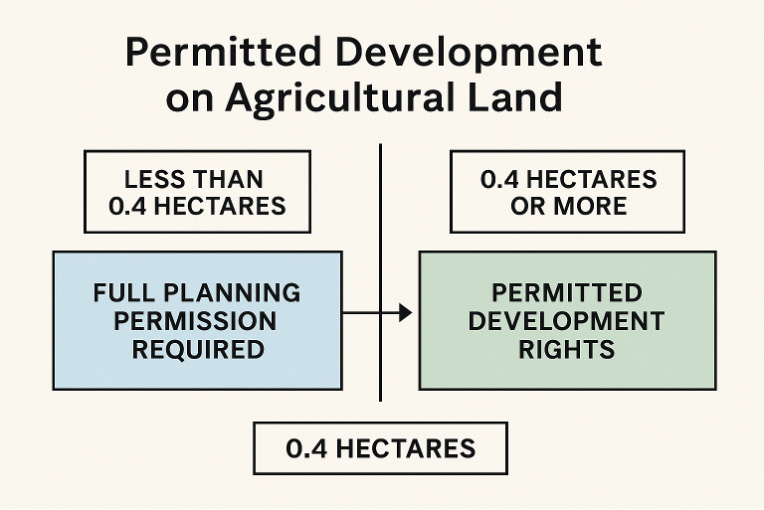
Most landowners assume that permitted development rights apply equally across agricultural land. Unfortunately, that’s not the case. The critical threshold of 0.4 hectares makes all the difference. Own less than 0.4 hectares of agricultural land, and the freedoms that many farmers and developers take for granted disappear.
This isn’t just an administrative quirk.

It’s the difference between straightforward progress and being stuck in the slow lane of full planning applications, added costs, and months of delay.
At Intelligent Land we work with landowners facing exactly this challenge. Using the Land Value Accelerator™ (LVA Method™), we help uncover overlooked opportunities, even on small parcels where conventional wisdom says, “nothing can be done.”
Why 0.4 Hectares Matters in Planning
The General Permitted Development Order (GPDO) sets out when you can develop agricultural land without applying for full planning permission.
- For units of more than 0.4 hectares but less than 5 hectares, certain limited rights exist, for example erecting small agricultural buildings, extensions, or works essential for farming operations.
- For land below 0.4 hectares, these rights don’t apply. That means almost all forms of new agricultural development require full planning permission.
The law doesn’t just look at individual parcels. It refers to the “agricultural unit” which is land occupied as a whole for farming, whether or not it’s split into different plots. That distinction often makes or breaks a case.
What You Can and Can’t Do Under 0.4 Hectares
If your landholding is under the 0.4-hectare threshold:
- You cannot rely on Class B agricultural permitted development rights.
- Any new building (even a modest shed or track) will normally require a full planning application.
- Certain “minor operations” may still be possible, but the scope is limited, and restrictions are tighter if your land sits within a protected area (National Park, AONB, Green Belt, etc.).
By contrast, land above the 0.4-hectare threshold may benefit from rights to erect or extend agricultural buildings, install hard surfaces, or carry out drainage works — all subject to size and height limits.
Beyond the Red Line: Protected Areas and Other Constraints
Even if your land meets the size threshold, location matters. We’ve already discussed permitted development on agricultural land less 0.4 hectares, but development rights can be curtailed or removed entirely on land:
- Within National Parks, AONBs, the Broads, or World Heritage Sites.
- Where Article 4 Directions are in place, restricting PD rights.
- Close to public highways or residential boundaries, where restrictions on height, distance, and use apply.
For small landowners, this is a double squeeze: less than 0.4 hectares and located in a designated area can mean even greater planning hurdles when it comes to maximising agricultural land value (read the guide).
How This Affects Land Value
When permitted development rights don’t apply, the barriers to unlocking value increase:
- Costs — preparing and submitting full planning applications is expensive.
- Delays — waiting months for council decisions can stall business plans.
- Risk — refusal rates for small-scale developments are high where land is under the threshold.
This directly impacts what buyers, investors, or developers are willing to pay for small agricultural plots. In some cases, parcels under 0.4 hectares are seen as liabilities rather than opportunities.
But with the right strategy, even small landholdings can be repositioned to capture value.
What to Do If You Own Less Than 0.4 Hectares
- Clarify the Agricultural Unit – check whether your holding is part of a wider unit. If multiple parcels are occupied together for agriculture, your total area may exceed 0.4 hectares.
- Review Planning History – permissions, refusals, or enforcement notices may all affect what’s possible.
- Check Local Policy – some councils are more flexible, particularly where rural diversification and sustainable farming are priorities.
- Consider Alternative Routes – change of use, flexible commercial permissions, or biodiversity net gain opportunities can create pathways to development.
How the LVA Method™ Unlocks Options
This is where Intelligent Land makes the difference. The Land Value Accelerator™ (LVA Method™) goes far beyond a quick planning check:
- Review Planning Permissions – we assess not just your parcel but the wider agricultural unit, identifying overlooked rights or misclassifications.
- Undertake Research – we layer in legal analysis, biodiversity net gain, ESG requirements, and local development policies.
- Scenario Testing – our AI models run thousands of planning and land-use scenarios to identify routes to higher value, often uncovering £1m+ uplifts within 24 hours.
Even when the rules look like a dead end, the LVA Method™ reveals paths that traditional consultants miss.
A Real-World Example Using Permitted Development on Agricultural Land Less Than 0.4 Hectares
One landowner came to us with a 0.35-hectare plot, dismissed by agents as “undevelopable.” Within a day, our AI scenario testing revealed the land was part of a larger agricultural unit through shared occupation agreements.
That single insight unlocked Class B permitted development rights, allowing a new agricultural building and a value uplift of over £500,000.
The lesson? Size matters – but context matters more.
Frequently Asked Questions
- Can I join multiple plots to exceed 0.4 hectares?
Yes, if they are occupied together as one agricultural unit for farming. This is often overlooked, but it can completely change your rights. - Does equestrian use count as agriculture?
Not usually. Grazing horses may qualify, but recreational equestrian use does not. This distinction is critical for permitted development rights. - What if my land is exactly 0.4 hectares?
You may qualify for Class B rights, but the measurement and definition of the “agricultural unit” need to be precise. A professional review can confirm your position.
Conclusion: Don’t Leave Value on the Table
If you own agricultural land under 0.4 hectares, the rules are restrictive – but they are not the end of the story. With expert analysis, reframing, and scenario testing, it’s possible to uncover hidden opportunities others overlook. For more information, you can read our ultimate guide to building on agricultural land, or… speak to us today to get help.
At Intelligent Land, we combine black-box AI insights with white-glove expertise to give you certainty, speed, and results with our land value optimisation strategy.
Ready to find out what your land is really worth? Unlock hidden millions today with the Land Value Accelerator™ – or talk to us about permitted development on agricultural land less than 0.4 hectares.


