
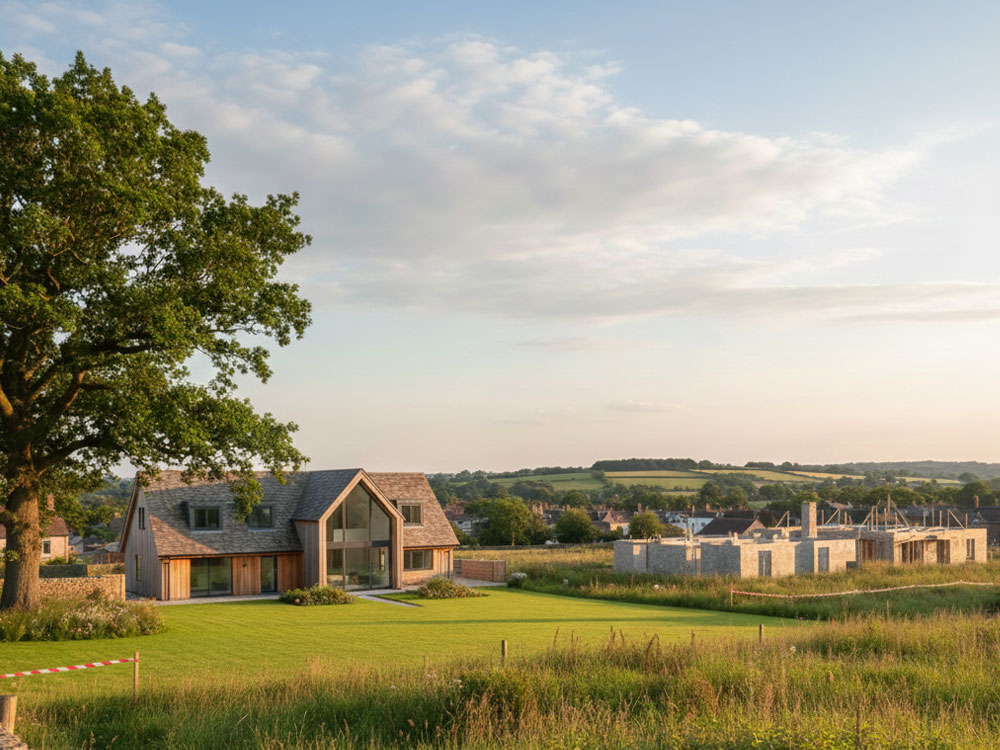
The short answer is yes, in most cases, having planning permission adds very real, very bankable value. But how much planning permission increases land value, how long it lasts, and what to do when you don’t have permission are all more subtle. And that’s where most landowners leave serious money on the table.
This guide walks through:

- How much planning permission can increase land value
- How long planning permission lasts in the UK
- How to value land without planning permission
- And crucially, how Intelligent Land’s Land Value Accelerator™ (LVA Method™) can help you unlock hidden millions, not just tick the “planning granted” box.
Does planning permission add value?
Planning permission nearly always adds value because it turns hope into a legally recognised right to develop.
Without planning, you’re selling a “maybe”.
With planning, you’re selling a “yes, subject to conditions”.
That shift from uncertainty to certainty is what developers, lenders and institutions are willing to pay for.
Independent research and market guidance consistently show that:
- Planning permission for homes can add around 10% or more to value in many areas, particularly where permission adds extra space or units.
- For land, the impact can be exponential. Government figures quoted in planning commentary suggest residential permission can move agricultural land from roughly £22,000 per hectare to around £1.95 million per hectare in some cases.
- On Green Belt and edge-of-settlement sites, planning consent can make land hundreds of times more valuable when it shifts from agricultural use to residential development.
So yes, planning permission adds value to land – but it doesn’t add the same value for everyone.
Two sites can both “have planning permission” and yet one is quietly worth seven figures more because:
- the layout is smarter,
- the obligations are structured more efficiently, and
- the conditions are written in a way that de-risks delivery instead of scaring buyers.
That difference is exactly what the Land Value Accelerator™ (LVA Method™) is designed to uncover and quantify. Either before planning permission, or post.
How much does planning permission increase land value?
Most people who want to know how much does planning permission increase land value are secretly hoping for a neat multiple they can plug into a spreadsheet.
Real life is messier – and more profitable if you handle it properly.
Typical value uplifts
Based on market guidance and advisory articles:
Houses and small plots
Planning permission for an extension, extra bedroom or new dwelling on part of the garden can often add up to 10%+ to the property or residential land value, sometimes significantly more in prime areas like London and Edinburgh.
Garden and infill land
Where garden or side plots can be carved out with permission for a separate unit, the planning uplift can move from “spare land” pricing to full residential plot value – a substantial jump reflected in homeowner and valuation guidance.
Agricultural or strategic land
When farmland or edge-of-town fields obtain residential planning permission, the uplift in land value is often dramatic. Figures cited in planning literature suggest increases from tens of thousands per hectare to seven-figure per-hectare values, depending on location and density.
But those are just the headlines. The real driver is not simply “planning permission = more”; it’s what kind of permission, on what terms, and for what scheme.
The five big drivers of planning-led value
In practice, the impact of planning on land value depends on (at least) five things:
1. Quality of the consent
- Full vs outline vs permission in principle.
- Clarity of access, design parameters and reserved matters.
2. Conditions and obligations
Section 106 triggers, CIL, BNG and ESG obligations can either be phased intelligently or loaded up front, which can dramatically change what a buyer will pay.
3. Density and mix
A permission that under-utilises the site (e.g. too few units, poor mix) may technically be “consent”, but it’s leaving value on the table.
4. Market context
The same permission in a high-demand commuter belt versus a weaker local market will command very different land bids.
5. Perceived deliverability
Clean, well-structured permissions with robust technical packs, clear access and sensible conditions attract more bidders and cheaper capital. That perceived certainty translates directly into higher land value.
This is why Intelligent Land is sceptical of any generic “planning adds X%” rule. Permission is not a badge; it’s an opportunity design problem.
The LVA Method™ treats your planning permission as a starting point, not the finish line – testing different densities, mixes, phasing strategies and obligation structures to see how far the uplift can go, not just whether the permission exists.
How long does planning permission last?
Another question that comes up again and again: “How long does planning permission last?”
For most readers in England and Wales, the broad position is:
Full planning permission
Full planning permission typically lasts three years from the date consent is granted. You must start development within that period or the permission lapses.
Outline planning permission
Often gives you three years to submit reserved matters, and then a further two years to commence development once those reserved matters are approved – effectively up to five years in a standard scenario, unless your decision notice says otherwise.
Local variations and conditions
Some permissions – particularly certain residential proposals since 2020 – include conditions requiring a start within two years instead of three, so it’s important to read the decision notice carefully.
Once lawfully started, it doesn’t “expire”
Guidance generally confirms that once a material start has been made (and properly inspected/recorded), the permission endures – even if you pause or build out slowly.
In Scotland and Northern Ireland, full planning permission typically lasts up to five years, subject to the local planning authority’s conditions.
This timing matters for value because:
- The closer a permission gets to expiry, the more nervous bidders and lenders become.
- A permission that has been lawfully implemented (foundations in, conditions discharged, etc.) often commands higher value because it’s seen as “locked in” rather than speculative.
One of the first things the LVA Method™ does is review timing, conditions and implementation status so you’re not accidentally marketing a “use it or lose it” consent as if it were a fully secure long-term asset.
How do you value land without planning permission?
Valuing land without planning permission is part science, part psychology.
Most valuers and developers think in three layers:
1. Existing Use Value (EUV)
What is the land worth today in its current authorised use? For example, agricultural land at agricultural values.
2. Hope Value
An additional amount reflecting the probability and scale of future planning permission. This sits between current use and full development value. Read more about hope value here.
3. Residual Land Value (RLV)
A backward calculation: estimate the future Gross Development Value (GDV), deduct all costs (build, infrastructure, finance, professional fees, BNG/ESG obligations, Section 106, contingencies), and what’s left is the land value you can justify paying.
Without planning permission, you are effectively pricing risk and uncertainty:
- How likely is a policy change or allocation?
- Are there access, flood, ecology or heritage constraints that kill or shrink a scheme?
- What might future BNG or ESG requirements do to costs and net developable area?
Two valuers can look at the same field and – quite logically – come up with wildly different numbers if they have different assumptions about timing, density and deliverability. Here’s what we say determines land value.
Where most landowners lose out
Many landowners accept:
- A “strategic” offer that heavily discounts future planning risk; or
- A planning application that aims for the obvious layout or housing mix rather than the optimal one.
The cost of that caution isn’t a line item on an invoice. It shows up as millions quietly missing from the land receipt.
What the Land Value Accelerator™ (LVA Method™) does differently
Intelligent Land built the Land Value Accelerator™ (LVA Method™) to answer a simple question:
“If planning permission can increase land value so dramatically, how do we make sure we’re not stopping at the first sensible answer?”
Instead of treating planning as a yes/no outcome, the LVA Method™:
1. Reviews Planning Permissions
- Checks exactly what has been granted (or is likely), including conditions, triggers and timings.
- Assesses expiry risk, implementation status and any “poison pill” clauses that might put buyers off.
2. Undertakes Deep Research
- Technical constraints (access, utilities, flood, ecology).
- Planning policy, BNG and ESG requirements.
- Market demand for different tenures, unit mixes and densities.
3. Runs AI-Driven Scenario Testing
- Our models run thousands of scenarios – testing density, mix, phasing and obligation structures – to identify combinations that maximise residual land value without ramping up risk.
Think of it as an “explore engine” for land value. Instead of testing one or two layouts in Excel, we map the full fat-tailed upside: the non-obvious configurations that conventional appraisals often miss.
That’s why some clients see £1m+ of additional value identified within 24 hours – not because the land changed, but because the story around that land did.
So… does planning permission add value – and what should you do next?
Yes, planning permission adds value. In some cases, it turns modest fields into assets worth tens of millions.
But the more important question is:
Are you getting full value from your planning permission – or just the obvious value?
If you:
- Have planning permission and suspect the land might be worth more than the current offers,
- Are about to apply for consent and want to design the most valuable permission, not just the most convenient, or
- Hold land without planning permission and want a clear, scenario-tested view of its true potential…
…then it’s time to run the LVA Method™.
Unlock hidden millions in your land value
Land Value Accelerator™ – Unlocking Hidden Millions.
Black-Box Insights, White-Glove Results.
Use the LVA Method™ to:
- Stress-test your existing planning permission.
- Quantify realistic upside across multiple scenarios.
- Present a cleaner, more compelling story to developers, funders and buyers.
Next step:
Book an LVA Value Acceleration Estimate with Intelligent Land and see, in black and white, how much more your land could be worth with the right planning strategy behind it.


