

If you’re running a farm or advising one, you don’t need telling that the old model is under strain. Input costs up. Farm-gate prices stubborn. New schemes, new acronyms, new inspections. At the same time, government expects the countryside to deliver food, housing, nature recovery and low-carbon energy on the same acres of land.
It’s no wonder many farmers feel stuck between “keep grafting and hope” and “sell up and walk away”.

This guide to farm diversification is for the middle ground.
It’s for farm owners and land agents who want practical farm diversification ideas, but who suspect that the real step-change may come not from another side business, but from planning-led development and land value uplift.
And that’s where Intelligent Land and our Land Value Accelerator™ (LVA Method™) come in.
What Is Farm Diversification – In Plain English?
At its simplest, farm diversification means using your land, buildings and natural assets for non-traditional income, alongside or instead of food production.
That could be anything from letting out a barn for storage to creating a habitat bank for biodiversity net gain, to promoting part of the holding for housing or commercial use.
Two important points:
- Farm diversification is not “giving up farming”. Done well, it’s about adding resilience, smoothing cashflow and protecting the family inheritance, not abandoning the land.
- Not all farm diversification is equal. A farm shop might add a useful income stream. A well-timed planning consent might fundamentally change the capital value of part of your holding.
Most articles on “what is farm diversification” stop at cafés, glamping and pick-your-own. Helpful, but incomplete ideas that will turn a true profit.
In reality, there are two broad families of opportunity:
- Business diversification: shops, tourism, hospitality, services.
- Planning-led land diversification: changes of use, building conversions, new development, habitat creation and environmental markets.
This guide to farm diversification ideas leans towards the second, because that’s where many of the most profitable farm diversification routes sit – if you approach them with good evidence, not guesswork.
Why Planning-Led Diversification Is Different
National planning policy is surprisingly clear on one thing: local plans and decisions should enable the development and diversification of agricultural and other land-based rural businesses.
Alongside that, a lot has changed in the last couple of years:
- Permitted development rights for farms have been expanded, giving more freedom to convert agricultural buildings to homes or commercial use, and to put up larger buildings without full planning permission (read about permitted development rights on agricultural land).
- Biodiversity Net Gain (BNG) is now mandatory for most developments in England, requiring at least 10% biodiversity improvement, often secured for 30 years – and developers can buy off-site units from landowners when they can’t deliver it on their own red line (read BNG opportunities for farmland).
- The National Planning Policy Framework (NPPF) has been revised again to boost housing delivery, re-introducing stronger housing targets and pushing councils to find more land, including reviewing Green Belt and new “grey belt” categories.
Put bluntly: policy is nudging your land in several directions at once.
Most farmers respond by doing nothing, because it feels safer than choosing wrongly.
But in planning terms, doing nothing is still a decision – and sometimes it’s the most expensive one over a five- to ten-year horizon.
Planning-led farm diversification is different because:
- It doesn’t just add a bit of income.
- It can redefine what your land is for in the eyes of planners, lenders and buyers.
That’s where Intelligent Land’s LVA Method™ comes in. Instead of you guessing where the value in farm diversification might be, we use AI-driven scenario testing plus 30 years of planning experience to map it out.
If you’d like a quick sense of what planning-led farm diversification might mean for your own holding, request a free Farm Diversification Viability Snapshot with Intelligent Land. No drawings, no commitment – just a high-level view of where value might be hiding.
The Most Profitable Farm Diversification Ideas Today: Planning-Led Routes
Every farm is different, but when we talk about the most profitable farm diversification ideas and opportunities we tend to see the same school of thought coming up again and again.
They all have one thing in common: planning permission or permitted development rights are the lever.
1. Converting Redundant Buildings to Homes or Commercial Use
Recent changes to permitted development rights in England mean many farmers can now convert larger agricultural buildings to home or commercial uses such as offices, shops, cafés or gyms, with a more generous size threshold and wider list of acceptable uses.
On paper, that sounds straightforward. In practice, each building sits in a particular planning context:
- Access and highways
- Flood risk and drainage
- Heritage or landscape designations
- BNG and ecology issues
- Neighbour amenity, noise, odour, traffic
Get it wrong and you spend money on drawings, reports and applications that go nowhere.
With the Land Value Accelerator™, we start by digitally “stress testing” each building and the surrounding land:
- What’s the realistic range of outcomes – storage, commercial, residential?
- How does each option impact value, cashflow and risk?
- What are the showstoppers you need to know about before you brief an architect?
Sometimes the result is “leave it alone”. Sometimes it’s “this quiet corner of the farm could be worth six or seven figures with the right consent”.
2. Strategic Land for Housing or Mixed-Use Development
Not every farm sits next to a settlement. But where land adjoins – or effectively forms part of – a village, town or city edge, there can be strategic development potential and one of the more interesting farm diversification ideas.
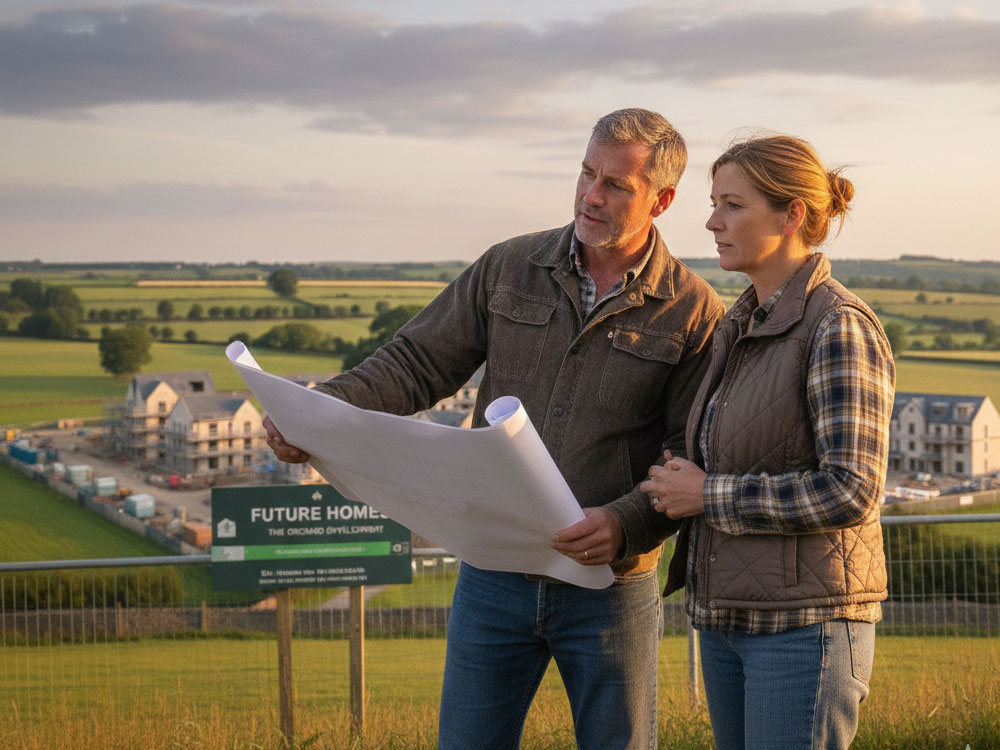
The planning landscape is fluid:
- Councils are under ongoing pressure to hit housing targets.
- National policy talks about brownfield first, but in practice, edge-of-settlement sites and even some Green Belt or “grey belt” land are in play where local plans are under review.
For a farmer or land agent, the key questions are:
- Is this land genuinely promotable in the next plan cycle?
- At what scale – a handful of houses, or a larger allocation?
- Should we work with a promoter or developer, or retain more control?
- How does taking this land out of agriculture affect the rest of the holding?
The LVA Method™ models different scenarios – from “do nothing” to full allocation – comparing the likely value uplift, timeframes and risk profile of each. It combines planning policy, market data and constraint mapping into one clear picture.
Often, the most profitable route is not the one people assumed at the outset.
If you’re quietly wondering whether a field on the edge of the village has development potential, book a free Land Value Discovery consultation to talk through options.
3. Biodiversity Net Gain (BNG) and Habitat Creation
BNG has gone from “something the planners are talking about” to a legal requirement for most developments in England, with a minimum 10% biodiversity uplift and 30-year management.
Many developers can’t deliver all of that on their own sites. They will increasingly need to buy off-site biodiversity units from landowners.
For farms, that can mean:
- Creating or enhancing woodland, wetlands, species-rich grassland or other priority habitats.
- Entering into long-term legal agreements that secure management and generate an income stream.
The upside can be significant. The risk is committing the wrong land, in the wrong way, at the wrong time, and closing off future development options.
With the Land Value Accelerator™, we:
- Identify which parts of the farm are strongest candidates for habitat creation.
- Check how BNG opportunities interact with potential housing, commercial or energy projects.
- Model income and capital value under different deal structures.
The result is not just “BNG sounds good”, but “this field over here might be better as habitat; that field over there is more valuable kept in play for future development”.
4. Energy, Storage and Infrastructure
Solar farms, battery storage, substations, grid connections, access land – these are often described as “golden tickets”. They can be profitable farm diversification ideas, but only when the rural planning permissions and grid stars align.
Grid capacity, landscape sensitivity, cumulative impact and policy all play a part. A neighbouring scheme can help or hinder you.
LVA looks at:
- Whether your land sits in a realistic “search area” for energy or infrastructure.
- The likely scale of opportunity and the constraints.
- How to balance long leases with family and succession planning.
Sometimes the right move is to invite offers from energy developers. Sometimes it’s to sit tight. The value is in knowing which.
5. Small-Scale Commercial, Tourism and Workspace on Farm
Lastly, there are the more familiar farm diversification examples: farm shops, cafés, livery, holiday lets, rural work hubs, storage or light industrial units.
These can work very well where:
- There is strong local demand.
- Access, parking and traffic can be handled.
- The use reinforces, rather than undermines, the core identity of the farm.
The planning angle matters. A modest commercial consent, or a lawful established use, can change how the bank sees your yard or your buildings. It can also open options to sell, refinance or grow in future.
With LVA, we treat these as part of the overall picture. A café or workspace is not just a business idea; it’s one scenario among several that can be compared on risk, effort and return.
Other Farm Diversification Examples
It’s worth acknowledging other farm diversification ideas that many farmers consider:
- Agritourism and glamping
- Educational visits and open days
- Livery and equestrian facilities
- Processing and selling your own produce
- Storage, workshops and craft units
- Events and experiences
All can add useful income and community connections.
The caution is this: many require long hours, staff, marketing and customer service, on top of everything else. They can be rewarding, but they rarely match the impact of a well-chosen planning consent on the value of a specific parcel of land.
A smart approach is often:
- Use lighter-touch diversification (for example, seasonal glamping or events) as interim uses.
- In parallel, use LVA to explore longer-term planning-led options for the same or other parts of the holding.
That way, you’re not betting the farm on a single idea. You’re testing, learning and keeping your options open.
How the Land Value Accelerator™ (LVA Method™) Works for Farms
Intelligent Land exists for one reason:
- Land Value Accelerator™ – Unlocking Hidden Millions.
- Black-Box Insights, White-Glove Results.
We combine proprietary AI with three decades of planning expertise to give landowners and agents a faster, clearer route to decisions.
For farms, the LVA Method™ runs in three steps.
Step 1 – Review Planning Permissions and Policy Context
We start with an audit of the planning landscape around your holding:
- Existing consents and conditions
- Past refusals on or near the farm
- Local plan designations, housing supply position and review timetable
- Constraints such as flood zones, heritage, landscape or Green Belt
- National policy changes that might shift the odds
The aim is simple: understand what’s really possible, not what’s been picked up over the gate or at the market.
Step 2 – Undertake Research
Next, we layer in technical, legal and market research, tailored to rural land:
- Access, highways and utilities
- Ecology, BNG and other ESG factors
- Demand for housing, logistics, tourism or workspace in your area
- Emerging land-use debates that may affect your choices over the next decade
This is where the “black box” AI does the heavy lifting – cross-referencing dozens of data sources quickly – while the human planning judgment keeps everything grounded and realistic.
Step 3 – Scenario Testing
Finally, we use the data to test multiple scenarios:
- Do nothing
- Light diversification (for example, building conversions only)
- Full planning-led strategy (for example, part development, part habitat creation, part ongoing agriculture)
For each, we look at likely value uplift, costs, timeframes and risk. In many cases, we can identify headline opportunities – including potential £1m+ value uplifts – often within 24 hours of getting the right information.
Just as importantly, we can show where not to spend money chasing the wrong idea.
If you’d like to see what this looks like on your own holding, book a free Land Value Discovery consultation. We’ll walk you through how LVA would approach your farm – and whether it’s worth taking further.
“We’re Too Small / It’s Too Risky / The Rules Will Change”
If you’ve read this far, there’s a good chance one of these thoughts has popped up:
“Planning is too expensive and risky.”
You’re right that a full application, with drawings and reports, is a serious commitment. That’s precisely why we built LVA: to give you a low-cost, low-risk viability snapshot before you get the cheque book out. You only move to detailed design once the numbers and the policy context make sense.
“We’re too small for development.”
Some of the best outcomes we see are on relatively modest holdings: a handful of converted barns; a small edge-of-settlement scheme; a carefully designed habitat project. You don’t need thousands of acres to benefit from planning-led diversification.
“The government will change the rules anyway.”
Planning and environmental policy do change – BNG, housing targets, Green Belt, land-use frameworks, all of it.
But doing nothing for fear of change is still a bet, and it often means missing windows of opportunity when policy is actually in your favour.
LVA is built to be re-run. As rules evolve, scenarios can be refreshed. The point is not to predict the future perfectly, but to be less in the dark than everyone else.
Underneath all the acronyms, most farm decisions come down to three things:
- Security
- Practicality
- Family stability and inheritance
Planning-led diversification, done properly, can support all three.
Next Steps: Get a Quick Snapshot of Your Farm’s Diversification Potential
If you’re curious – even just mildly – about how all this might play out on your own farm, the easiest next step is simple:
- We’ll provide a free, no-obligation viability snapshot highlighting where planning-led opportunities may sit – and where they probably don’t.
- Book a Land Value Discovery consultation to talk through the Land Value Accelerator™ (LVA Method™) in the context of your specific fields, buildings and family plans.
No pressure, no hard sell. Just a clearer view.
Farm smarter, not harder. Your next harvest could be from planning gain.


