
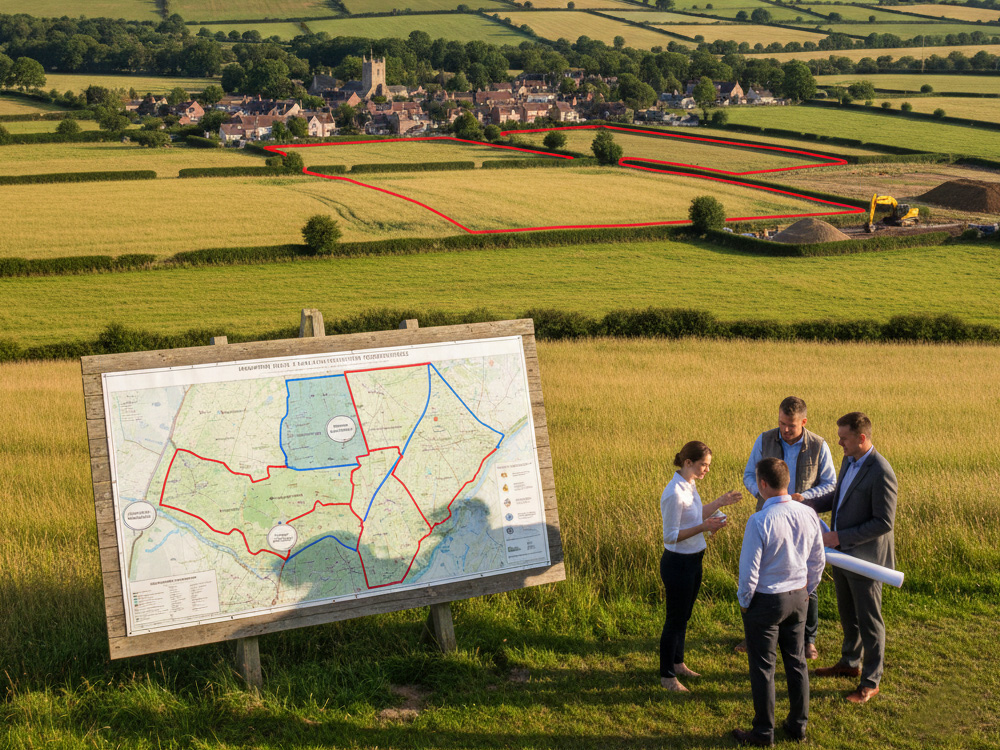
Rural Hampshire is under pressure.
Farms, paddocks, smallholdings, redundant barns and edge-of-village plots that once sat quietly on the books are now right in the firing line of housing demand, diversification, nutrient neutrality conversations, and environmental regulation.

The challenge for landowners isn’t whether change is coming.
It’s how to turn that pressure into opportunity, all without being stalled by planning policy, tripped up by Biodiversity Net Gain (BNG), or nudged into the wrong strategy (and losing years, not months).
That’s where Intelligent Land comes in.
We act as rural planning consultants across Hampshire, with one very specific focus:
Land Value Accelerator™ – Unlocking Hidden Millions.
Black-Box Insights, White-Glove Results.
Where in Hampshire do rural planning opportunities show up most?
Hampshire isn’t one market, but it’s multiple micro-markets stitched together by different local plans, landscape constraints, housing pressures and political realities.
We routinely support rural landowners and developers across:
- The New Forest fringe (Lymington, Brockenhurst, Ringwood edges, Hythe, Fawley hinterland) – typically high sensitivity, high scrutiny, but persistent demand pressure.
- Winchester and the Meon Valley (Bishops Waltham, Wickham, Hambledon, Exton) where countryside protection meets strong values.
- Test Valley (Romsey, Stockbridge, Andover edges) – strategic growth pressure and village-edge opportunities.
- East Hampshire / South Downs edge (Petersfield, Liss, Alton outskirts) – landscape designations and settlement strategy are everything.
- North Hampshire (Basingstoke, Tadley, Whitchurch, Overton, Fleet, Yateley) – commuter-driven demand and “deliverable site” pressure.
- South Hampshire hinterland (Fareham, Havant, Eastleigh edges, Southampton) – constrained land supply, intense competition, and policy tension.
- Rural river valleys and chalk landscapes (Itchen, Test, Hamble corridors) – constraints-heavy, but often value-rich when handled properly.
If your land sits near a village, a service centre, a transport corridor (A34 / M3 / A3 / A303), or has redundant buildings with access, you’re usually not looking at a simple “yes/no” planning question.
You’re looking at a value optimisation question.
Why rural planning in Hampshire is different
Hampshire has two forces pulling in opposite directions:
1. Strong countryside protection – national parks, protected landscapes, settlement gaps, heritage villages, dark skies, ecology, floodplains, and designations that are (rightly) taken seriously.
2. Relentless need for delivery – housing targets, five-year supply debates, rural economy support, and pressure to find sites that can actually be built.
This creates the familiar paradox:
- On paper, your land is “protected countryside”.
- In practice, local authorities still need deliverable sites and viable rural economies.
Our role as rural planning consultants is to read that tension correctly – then design strategies that work with policy rather than headbutting it.
How Intelligent Land helps rural landowners and farmers in Hampshire
Intelligent Land combines 30 years of planning and development experience with proprietary AI-driven analysis to help rural clients across Hampshire:
- Assess the real planning potential of agricultural and countryside land
- Choose between permitted development routes (like Class Q and Class R) and full planning applications
- Structure proposals that satisfy local and national policy – while still making commercial sense
- Optimise schemes for land value, saleability and long-term income
Typical rural projects include:
- Converting redundant barns to homes using Class Q prior approval (where genuinely eligible)
- Rural diversification – workshops, farm shops, tourism, storage, equestrian facilities, commercial yards
- Edge-of-settlement housing or mixed-use schemes near villages and market towns
- Small clusters of homes or live-work units on former agricultural sites
- Strategic long-term promotions where settlements are expected to grow
At every stage, we’re not just asking: “Can this get planning?”
Instead, we’re asking: “What’s the most valuable form of consent we can realistically achieve?”
The Land Value Accelerator™ (LVA Method™) – built for rural land
Most planning consultants analyse your site through a policy lens.
Intelligent Land does that – then goes a step further.
We use the Land Value Accelerator™ (LVA Method™) to treat every rural site as a value puzzle to be solved.
For rural and agricultural land in Hampshire, the LVA Method™ follows three key stages:
1) Review planning permissions and status
We start by reviewing:
- Existing consents, historic applications and refusals
- Allocation status in adopted or emerging plans
- Constraints – landscape designations, flood risk, heritage, access, ecology, agricultural ties
This shows us where the planning “fence lines” really are – and whether you’re better off with a permitted development route, a targeted full rural planning permission application, or longer-term strategic promotion.
2) Undertake research – technical, legal, BNG and policy
Next, we undertake deep research across:
- Technical issues – access, highways, drainage, utilities, contamination
- Legal and ownership matters – title quirks, access rights, overage, covenants
- Planning and policy – countryside protection, settlement strategy, housing need, rural worker policies and diversification support
- BNG and environmental factors – how to meet the minimum 10% BNG requirement efficiently, and where useful, leverage off-site habitat creation or credits
3) Scenario testing – finding the optimal rural value
Finally, we use AI-driven models to test different scenarios for your land:
- Barn conversions vs new-build courtyard homes
- Fewer, larger units vs more, smaller ones
- Residential vs commercial, tourism or mixed use
- Straight sale vs promotion agreement vs JV structure
We then present a small number of clearly costed options, showing projected value uplift, planning risk and timescales for each.
In many cases, this Land Value Optimisation reveals opportunities to increase value by up to 40% per plot, or unlock £1m+ of additional land value that a conventional planning approach would have missed (often within 24 hours for early-stage strategy).
Planning on agricultural land in Hampshire – barns, fields and everything in between
A lot of rural planning confusion comes from one simple misconception:
“I’ve got agricultural land, so I can just build houses on it, can’t I?”
Unfortunately, it’s not that simple.
In broad terms:
- Class Q is a building-led route – certain agricultural buildings can be converted to dwellings, within strict limits and criteria, via prior approval
- Open fields usually require a full planning application and a strong policy-led case – anchored in settlement strategy, housing need, design quality, access, landscape impact and deliverability
That’s why, when we act as rural planning consultants across Hampshire, we typically break the strategy into three conversations (which can be supported by your internal content):
- Building on agricultural land
- Building without planning permission (where PD truly applies)
- Planning permission on agricultural land (full strategy + evidence base)
Key message: route first, design second.
Choosing the wrong route can waste years. The LVA Method™ is built to avoid that.
Using BNG and environmental policy to your advantage
Many rural landowners see Biodiversity Net Gain as a threat – something that will “eat into development value”.
Used intelligently, it can become part of your value story:
- On-site habitat can be integrated into higher-value layouts (better edges, premiums, stronger placemaking)
- Some landholdings can provide off-site BNG units for other developments, creating a new income stream (secured for long terms under the statutory framework)
One important update: on 16 December 2025, national reporting indicated government moves to exempt very small sites (under 0.2 hectares) from BNG requirements – a reminder that rules can shift quickly, and strategy needs to keep pace.
Our Hampshire rural planning work increasingly combines:
- A core development proposal (barn conversions, small housing cluster, tourism use); and
- A BNG / environmental strategy for less developable land, supporting both your application and potential external demand for habitat units.
Again, the LVA Method™ lets us model different combinations of development and habitat to see which yields the strongest overall return.
Why Intelligent Land over a “standard” rural planning consultant?
Most rural planning advice stops at: “Can we get consent?”
Intelligent Land’s approach to planning consultancy is deliberately different:
- We are development-minded – many of us have sat on the developer/promoter side of the table
- We use the Land Value Accelerator™ to expose options and “hidden” value that purely policy-driven reviews often miss
- We don’t aim for any consent – we aim for the most valuable, deliverable consent that stands up in front of officers, committees and inspectors
- We stay current with national policy shifts, including ongoing updates to the National Planning Policy Framework (NPPF)
If you’re a farmer, estate owner, rural landowner or investor in Hampshire, that means:
- Clarity – on what’s realistically possible (and what isn’t)
- Confidence – that you’re not leaving money on the table
- A plan – to move from idea → permission → profit
Next steps – talk to rural planning consultants who think like developers
If you’re searching for rural planning consultants in Hampshire, you’re probably at one of three stages:
- You suspect your land has development potential, but you’re not sure where to start
- You’ve been told “no” in the past and want to know if anything has changed
- You have buildings or land you’d like to use more intensively, but you’re wary of planning risk
Wherever you are, Intelligent Land can help you turn uncertainty into strategy – and strategy into tangible value uplift.
The simplest way to begin is with a focused Land Value Optimisation review of your rural or agricultural landholding. We’ll use the LVA Method™ to map your options, quantify the value at stake, and recommend the best route forward.
Unlock hidden millions today.


